Archive for the “Mathematics” Category


What a great find!

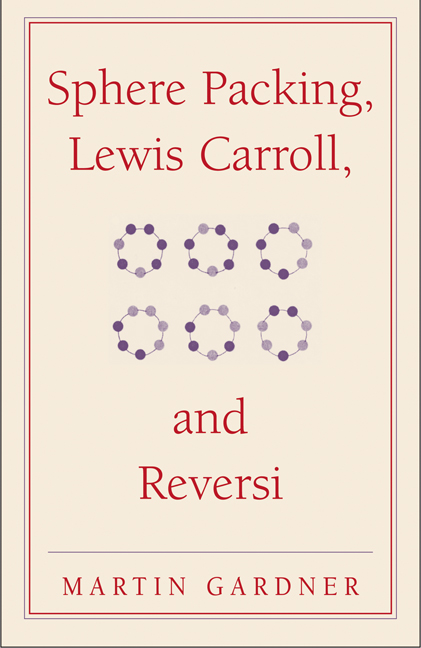
We’ve had a lot of fun with the new Martin Gardner books around here, but I always find that there is more to discover about him.

David Suzuki’s The Nature of Things featured an entire piece on Gardner, from his math buddies to the sleight-of-hand circles he frequented.

Thanks to Scott, over at Grey Matter for linking it from Encyclopedia Brittanica Online. I’ve embedded it below.

Anyone who has experienced the joys of embedding video may forgive me if playback is buggy.

It’s a Windows Media file, so anyone having trouble viewing can click here for the mp4 file.

+plus Magazine warns, in its recent review of Origami, Eleusis, and the Soma Cube, that his logic puzzles are not to be attempted on a hangover.

Share/Save/Bookmark

Tags:

Comments 2 Comments »

Shahn Majid

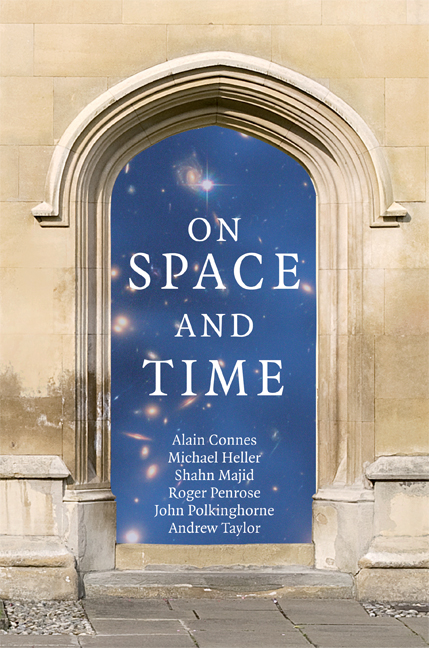
This will be my last regular post for a while because of Christmas and teaching three courses next term at my University. These past eleven posts, see here and here, have been my personal take on many of the topics covered in On Space and Time and its now time in this twelfth post to address the larger picture of the volume itself.

In fact the volume is about opening a genuine public debate on the true nature of space and time, starting with a public panel discussion on this topic in 2006 in Cambridge, England. Where this came from was my increasing unease about the portrayal of fundamental physics — quantum gravity in particular — as already solved by string theory when, in fact, theoretical physics is in need of fresh profound ideas and contact with experiment, when these are the most exciting and turbulent of times.

I also insist in the preface to On Space and Time that this debate needs to involve not only scientists but the wider public. The reason is that scientists’ ideas have to come from somewhere, from sitting around in cafes, from contemplation of art. We don’t know where the key revolutionary idea is going to come from. Put another way, to progress, scientists need now to see what Science is, which means they have to step outside it and see it in part as a non-scientist.
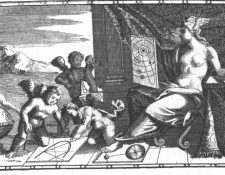
In particular, and this being Christmastime, I want you to ask yourself what does someone singing a Christmas carol have to say about quantum gravity? What does that person have in common with a theoretical physicist? What I think they have in common is contemplation of the infinite. I mean a sense of something bigger than ourselves. As a confirmed atheist I won’t call it God, but its a sense of awe at the Universe and a wonder about our place in it. My approach as a theoretical physicist is to use mathematics and the scientific method to explore the issue, while a carol singer is surely using other means to ‘connect’.

In fact it is only since the 17th century Enlightenment that Science somehow replaced religion as the font of physical truth. But the Scientific Method pioneered by Hooke and others replaced religious dogma, good, yet itself is based on certain assumptions and ways of doing things, of dividing knowledge into ‘theory’ and ‘experiment’, in other words some other dogma.

As a scientist I am 1000% committed to the Scientific Method but I see it as a particular way of exploring reality. One that we might now need to understand better by seeing it from the outside.

Read the rest of this entry »

Share/Save/Bookmark

Tags: ,

Comments No Comments »

First off, newly syndicated readers who want to have access to my previous posts can find them archived here as well as listed on my own site here.

After last week’s speculations on time I would like to ask an even deeper question: why is there time?

My 4 year old daughter would be proud. What I mean is, why do things evolve in the first place? It seems to me that fundamental physics has to answer not only ‘what’ questions but also ‘why’ questions if it claims to provide understanding. I think I have an answer, or a glimpse of one.

NASA

The answer has to do with quantum anomalies; no not the large (not very quantum, then) things that seem to turn up in every other episode of Star Trek Voyager, but what physicists mean by this, which I am afraid is much more dry and dusty. In fact, I’m going to have to ask you to dust off your high school calculus books, just for a minute.

I explained in a previous post that even if nobody at the moment knows how to reconcile quantum theory and gravity, quantum spacetime should emerge as an effect coming out of any unknown theory. Typically, the coordinates x,y,z of space would also be quantum variables, so space alone should typically form some kind of symbolic algebra. Due to quantum effects, the order of the variables in this algebra will matter, xy will typically not coincide with yx. One says that the algebra is ‘noncommutative’.

Click to enlarge

Now, what about differential calculus on such a quantum space? If you remember any high school calculus it means things like dx, dy, dz as the ‘infinitesimal differences’. Newton and Leibniz both considered such things as numbers which are then made arbitrarily small. Hands up if your high school calculus class contained a picture like the one shown at left. It defines differentiation of a function f in the x direction as a limit of the slope df/dx of the triangle as dx gets small.

So to develop quantum gravity effects in physics we also need ‘quantum differentials’ dx, dy, dz. They should enjoy the properties that differentials enjoy in Newtons theory except, since xy and yx need not coincide, similarly y dx need not coincide with dx y, etc. Now, here is the remarkable thing one finds as you dig deeper into this world of quantum geometry:

Read the rest of this entry »

Share/Save/Bookmark

Tags: , ,

Comments 5 Comments »

With the Martin Gardner books available, I’ve been throwing the word hexaflexagon around a lot. It’s part of the title, after all.

For anyone who hasn’t ever seen one, they’re cool. I came across this video of someone flexing a hexaflexagon made from a map; one of the more interesting applications I’ve seen.

Share/Save/Bookmark

Tags: ,

Comments No Comments »

Shahn Majid

Yikes.

First off, congratulations America! Electing the first black US president has to be significant and already puts Obama into the history books, whatever economic and other problems may loom worryingly in the future. Certainly his work will be cut out for him given the falls in the stock market and some of the dire predictions going forward.

Maybe in such times of history, change and future uncertainty, it is appropriate to reflect, then, what exactly do we mean by past, present and future? What is the cutting edge of modern physics telling us about these important concepts?

So far in these blogs I have focussed on hard science verifiable by experiment. But it is also part of the background to my multiauthored volume On Space and Time that to proceed further with fundamental science may need revolutionary new ideas for which science is still grasping. So this week we are going to let our hair down and extrapolate from what is understood into what is definitely, well, speculative.

Incidentally, I did run these ideas here past a BBC producer for Horizon a few years ago when he called me asking about the possibility of time travel, and obviously I was not controversial enough as he never called me back.

What I propose, as a motion for debate, is:

The direction of time is a spontaneously broken symmetry, in the same way as which side of the road to drive on is a spontaneously broken symmetry.

Read the rest of this entry »

Share/Save/Bookmark

Tags: ,

Comments 7 Comments »